The history of personal computing is filled with machines that became symbols of an era.
Two of the most recognizable names from the earliest days of themicrocomputer revolutionare theAltair 8800and theIMSAI 8080.
Both machines are closely associated with theIntel 8080processor, the S-100 bus, and the rapidly growing community of computer enthusiasts that emerged during the 1970s.
Today, both systems can be experienced again through the AltairMini range.
The Altair 8800
Introduced in 1975, the Altair 8800 became one of the defining machines of the early personal computer era.
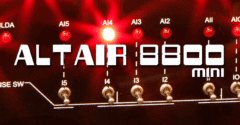
Its distinctive front panel, covered with switches and LEDs, became an icon of early computing.
The machine was designed primarily as an expandable computer system and became particularly important to hobbyists and developers interested in experimenting with microprocessors.
Its influence extended far beyond the original machine.
The Altair helped inspire software developers, hardware designers, and computer enthusiasts who would go on to shape the emerging personal computer industry.
TheIMSAI 8080
TheIMSAI 8080followed shortly after the Altair and became another important system in the early S-100 ecosystem.
Its distinctive blue front panel and rows of switches and indicators made it instantly recognizable.
Like the Altair, the IMSAI was designed around the Intel 8080 processor and an expandable S-100 architecture.
It became a popular platform for hobbyists who wanted to build and experiment with their own computer systems.
Two Machines, One Computing Revolution
Although the Altair and IMSAI have their own distinctive designs and histories, they belong to the same remarkable period.
This was a time when computers were no longer restricted to large institutions.
Enthusiasts could build systems, write software, design hardware, and share their discoveries with a rapidly growing community.
The S-100 ecosystem became an important part of this movement.
Why Are They Still Interesting?
Modern computers are vastly more powerful than anything available in 1975.
Yet the simplicity of these early systems has a unique appeal.
The front panel makes the operation of the computer visible.
Storage is tangible.
Programs are small enough to understand.
Hardware and software feel directly connected.
For many enthusiasts, this makes early microcomputers more engaging than modern machines.
Altair 8800 Mini
The Altair 8800 Mini recreates the distinctive experience of the original Altair in a compact modern system.
It is designed to allow enthusiasts to explore classic computing concepts while providing practical modern connectivity and expansion possibilities.
With support for peripherals, terminal operation, storage, and CP/M, it can become a complete retrocomputing environment.
IMSAI 8080 Mini
The IMSAI 8080 Mini brings the same philosophy to one of the most recognizable computers of the S-100 era.
Its distinctive appearance makes it an especially attractive choice for collectors and enthusiasts who have a connection with the original IMSAI.
But like the original machine, it is intended to be more than a display object.
It is a platform for exploration.
Which One Should You Choose?
The choice often comes down to personal preference.
If the classic Altair front panel is the image that first inspired your interest in early computing, theAltair 8800 Miniis the natural choice.
If you have always been fascinated by the distinctive IMSAI design and its place in S-100 history, theIMSAI 8080 Minioffers an equally compelling experience.
And for collectors and dedicated retrocomputing enthusiasts, having both provides a fascinating comparison between two of the most recognizable machines of the era.
Beyond the Computer
The real fun begins when you start expanding the system.
Storage, terminals, interfaces, and other peripherals allow you to recreate more of the computing environment surrounding these machines.
You can explore CP/M, experiment with software, connect peripherals, and even experience the world of early computer communications.
This is where retrocomputing becomes more than collecting.
It becomes an experience.
Preserving the Experience
The goal of modern reproductions is not simply to preserve the appearance of historic machines.
It is to preserve the curiosity and experimentation that made them special.
The Altair 8800 and IMSAI 8080 helped demonstrate that computing could be something individuals could explore for themselves.
That spirit remains at the heart of retrocomputing today.
Discover the Altair 8800 Mini, IMSAI 8080 Mini and the complete AltairMini ecosystem.