Long before modern desktop operating systems became standard, one operating system became a fundamental part of the earlymicrocomputer revolution.
Its name was CP/M.
For anyone interested in the history of personal computing, CP/M is much more than an old operating system. It represents an important period when computers were becoming accessible to individuals, small businesses, engineers, and hobbyists.
Today, CP/M remains one of the most fascinating ways to experience early personal computing.
What Does CP/M Stand For?
CP/M originally stood forControl Program for Microcomputers.
It was created by Gary Kildall and became one of the most widely used operating systems for 8-bit microcomputers.
Unlike modern operating systems, CP/M was designed for the hardware environment of its time.
It was efficient, relatively compact, and capable of running on many different computer systems.
Why Was CP/M Important?
During the early years of microcomputing, hardware platforms were often very different from one another.
Software compatibility was therefore a major challenge.
CP/M helped solve part of that problem by providing a common operating environment for many systems based on processors such as theIntel 8080and Z80.
Programs could therefore be developed for the CP/M environment and used across compatible machines with relatively little modification.
This was a major step toward the software ecosystem that modern computer users take for granted.
CP/M and theAltair 8800
The Altair 8800 is closely connected with the development of early microcomputer software.
The machine helped inspire a generation of programmers and entrepreneurs who would go on to shape the computer industry.
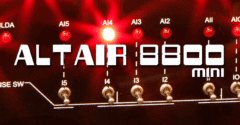
Exploring CP/M on an Altair 8800 Mini provides a fascinating opportunity to experience this period first-hand.
Instead of simply reading about early computing, you can interact with the software environment itself.
The CP/M Command Line
One of the most recognizable aspects of CP/M is its command-line interface.
There are no modern windows, icons, or graphical menus.
Instead, the computer waits for a command.
You type it.
The computer responds.
This simple interaction gives users a direct connection with the machine.
Commands such as directory listings, file copying, and program execution become part of the experience.
For modern users accustomed to graphical interfaces, CP/M can initially feel unusual.
For retrocomputing enthusiasts, that is exactly what makes it so interesting.
Working With Files
CP/M provides fundamental file-management capabilities.
Users can list files, copy files, rename files, delete files, and execute programs.
The simplicity of the environment makes it easy to understand the relationship between software, storage, and the operating system.
This makes CP/M particularly valuable from an educational perspective.
Classic Software
The CP/M ecosystem included an impressive range of software.
Programming languages, business applications, text processors, databases, utilities, and games were all developed for CP/M systems.
Software such as BASIC interpreters and early word-processing applications helped demonstrate that microcomputers could be useful for much more than experimentation.
They could become productive tools.
Experience CP/M Today
Modern computers hide almost everything from the user.
CP/M does the opposite.
It exposes the basic relationship between the user, operating system, programs, memory, and storage.
That makes it an excellent environment for learning about the foundations of personal computing.
The Altair 8800 Mini provides a practical way to explore that experience without requiring a room full of vintage equipment.
More Than Nostalgia
CP/M is sometimes viewed simply as a piece of computing nostalgia.
It is certainly nostalgic.
But it is also historically significant.
Understanding CP/M helps explain how personal computing evolved from simple microprocessor systems into the software-driven computer industry we know today.
It is a reminder that many of the concepts we use every day — files, programs, command interpreters, storage devices, and software environments — have roots in this early period.
Start Exploring
For retrocomputing enthusiasts, CP/M offers an opportunity to slow down and understand what happens behind the modern graphical interface.
For programmers, it provides a fascinating environment for experimentation.
For collectors, it brings an important part of computing history to life.
And for anyone curious about how personal computing began, it offers a direct connection to the technology of the late 1970s and early 1980s.
Explore CP/M on the Altair 8800 Mini and discover the software environment that helped shape the personal computer revolution.